Picture credits
The drawings are our own. The photos are from Wikimedia Commons, under Creative Commons licences (Attribution, or Attribution-ShareAlike), CC0, or in the public domain.
Photos
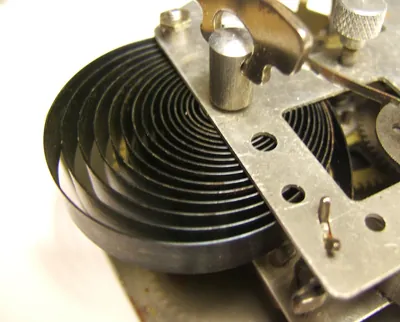
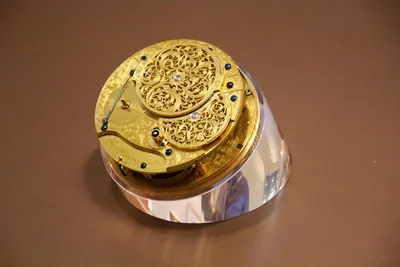 Harrison H4 clockwork 1.jpg
by Photograph by Mike Peel (www.mikepeel.net)., CC BY-SA 4.0. Cropped and resized; no other changes. Shared here under the same licence.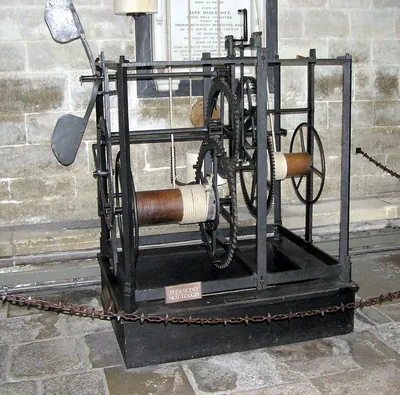 Salisbury.cathedral.clock.arp.jpg
by Arpingstone (Adrian Pingstone), Public domain. Cropped and resized; no other changes.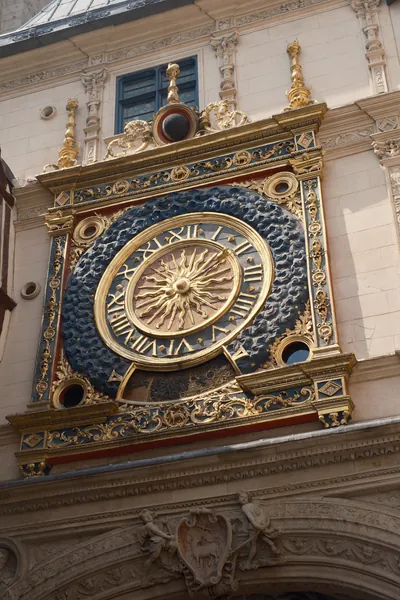
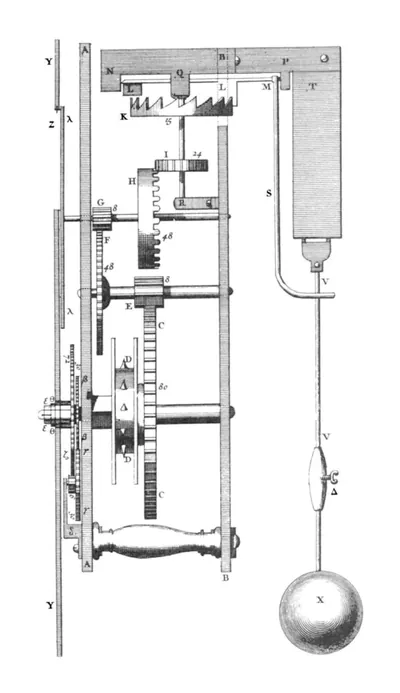
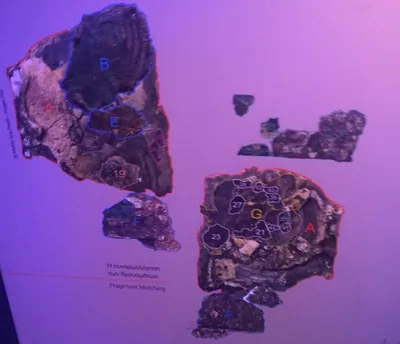 Antikythera, Národní archeologické muzeum v Athénách.jpg
by Moravec, CC BY-SA 4.0. Cropped and resized; no other changes. Shared here under the same licence.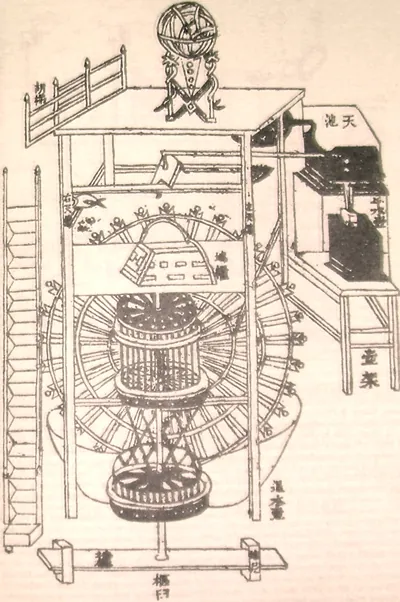 Clock Tower from Su Song's Book desmear.JPG
by Su Song, Public domain. Cropped and resized; no other changes.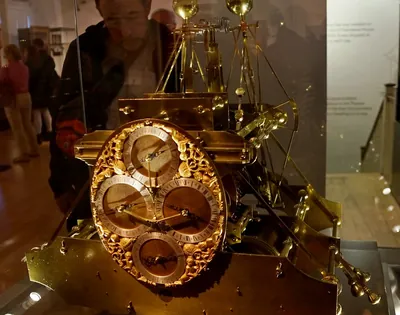 Clock that changed the world (H1, 1730-35) - Flickr - Tatters ❀.jpg
by Tatters ❀ from Brisbane, Australia, CC BY-SA 2.0. Cropped and resized; no other changes. Shared here under the same licence.
Our own drawings
- Two meshing gears. On the left a small orange pinion with 10 teeth, labelled turns twice; on the right a larger brass wheel with 20 teeth, labelled turns once, with twice the force. Arrows show them turning in opposite directions.
Our own drawing - Four small drawings in a row. Spur: two flat gears with straight teeth meshing side by side. Helical: a gear drawn as a drum with slanting teeth. Bevel: two cone-shaped gears meeting at a right angle. Worm and gear: a screw-like worm under a round gear.
Our own drawing - A schematic clock movement. A weight hangs from a line wound round the great wheel at the left. Arrows pass the motion along to the centre wheel, which turns once an hour and carries the minute hand, then the third wheel, then the escape wheel. Above the escape wheel are the pallets of an anchor, linked by the crutch to a long pendulum at the right. Below, a box labelled motion work, 12 to 1, links the minute hand to the hour hand.
Our own drawing - A verge-and-foliot escapement. At the top a horizontal bar, the foliot, with a small weight near each end and arrows saying move the weights out: slower. Hanging from its middle is an upright rod, the verge, with two small orange flags, the pallets, one high and one low, pointing in opposite directions. Beside the verge stands a crown wheel with saw-like teeth that catch on the pallets in turn. The crown wheel is turned by a drum with a rope and a hanging weight.
Our own drawing - An anchor escapement. A brass escape wheel with pointed teeth sits below a dark curved anchor whose two orange pallet tips dip between the teeth. A long pendulum rod hangs down past the wheel to a round brass bob at the bottom.
Our own drawing - Three pendulums hanging from one beam. The middle one is long, labelled about 990 mm, 1 second a swing. The left one is a quarter of that length, labelled half a second. The right one is half the length, labelled about 0.7 seconds.
Our own drawing - A fusee and barrel. On the left a brass cone with a spiral groove; on the right a grey drum containing a coiled mainspring. A chain runs from the narrow end of the cone to the drum. Notes say fully wound, the chain pulls on the narrow end; running down, it pulls on the wide end.
Our own drawing - A brass balance wheel with three spokes, and inside it a blue spiral balance spring coiled round the centre. Orange arrows show the wheel swinging to and fro.
Our own drawing - A bar chart of error per day on a log scale. Early tower clocks: up to 30 minutes, the longest bar. Huygens’s first pendulum clock: under 1 minute. Huygens improved: under 10 seconds. Graham, 1721: 1 second. Harrison’s chronometer at sea: about a fifth of a second. Riefler, 1889: a hundredth of a second, the shortest bar.
Our own drawing
The drawings are simplified teaching drawings, not to scale, made from the sourced descriptions on this site. Useless the eraser is the network’s own mascot. Fonts: Bricolage Grotesque, Newsreader and Kalam (SIL Open Font Licence), served from this site.