The escapement: the part that ticks
Without it, the weight would just fall and the gears would spin. With it, they move one tooth at a time.
How this site works. Every fact is in our own words and linked to its source, beside it. Where good sources disagree, we show each version in a “Sources differ” box.
An escapement lets motion happen in controlled steps. Britannica
In a clock or watch it controls how energy passes from the power source to the counting mechanism. Britannica
The real innovation of the weight-driven clock was the escapement, which handed the pull of the falling weight on to the counting gears. Britannica
The escapement is what makes the tick-tock of a weight-driven clock. Britannica
The first one: verge and foliot
The verge escapement, the classic early form that made the mechanical clock possible, was probably invented in 13th-century Europe. Britannica
It has a crown-shaped wheel, driven by a weight, whose teeth are stopped in turn by a pair of metal pallets. Britannica
The pallets sit on an upright rod, the verge, topped by a crossbar called the foliot with two small weights; moving the weights outwards slows it down. Britannica
The verge-and-foliot was the most common escapement. Britannica
Versions of the verge and foliot ruled for more than 300 years. NIST
Their weak point: how fast they swung depended heavily on the driving force and on friction. NIST
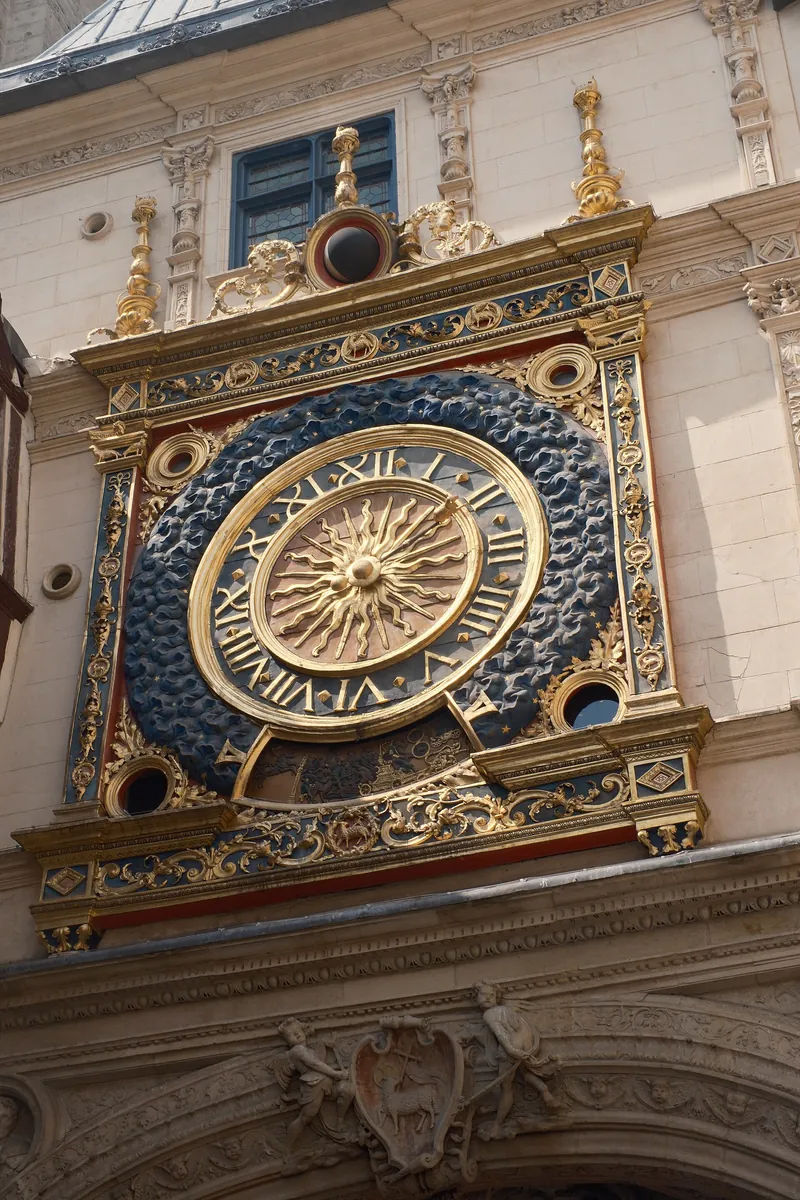
A clock put up at Rouen in France in 1389 still survives. Britannica
The anchor
Press Tick: the anchor rocks and the wheel moves on half a tooth.
Our own animation of the idea: each tick the anchor rocks and lets the wheel creep on, so one tooth passes for each double swing Britannica.
The anchor escapement, invented in England in the 17th century, works with a pendulum and needs much smaller swings than a verge with a pendulum. Britannica
Its pallets are shaped like an upside-down anchor, in the same plane as the wheel. Britannica
The anchor was a big step up because it disturbs the pendulum less than the verge does. NIST
In a pendulum clock the escape wheel moves on one tooth for each double swing and gives the pendulum a push to keep it going. Britannica
When did the anchor arrive? Sources differ
- Britannica says English clockmakers brought in the long, seconds pendulum with the anchor escapement in 1670. Britannica
- NIST says William Clement began building clocks with the anchor, or recoil, escapement in London in 1671. NIST
Both put it in England around 1670; they differ by a year and in whether they name a maker.
Better and better
An ideal escapement would push without getting in the way of the free swing, and push the same every time. Britannica
Later escapements were made as detached as possible, giving the swinging part energy while leaving it free to swing. Britannica
Edmund Beckett, later Lord Grimthorpe, invented the double three-legged gravity escapement for the great clock at Westminster, now known as Big Ben, installed in 1859. Britannica
It became the standard for really accurate tower clocks. Britannica
In your watch: the lever
Most mechanical watches use the lever escapement, invented in England about 1755 by Thomas Mudge. Britannica
It leaves the balance free to swing, touching it only to give its push and to be unlocked. Britannica
The lever is by far the most important watch escapement today. Britannica
Next: the pendulum →