The pendulum: why a swing keeps time
A weight on a string turned clocks from roughly right to properly right.
How this site works. Every fact is in our own words and linked to its source, beside it. Where good sources disagree, we show each version in a “Sources differ” box.
A pendulum is a weight hung from a fixed point so it can swing back and forth under gravity. Britannica
Pendulums regulate clocks because each complete swing, the period, takes the same time. Britannica
For small swings, the period depends only on the pendulum’s length, and hardly at all on how wide it swings. Britannica
A heavier bob does not change the period, as long as the length stays the same. Britannica
Make a pendulum longer and it swings more slowly. Britannica
Our own arithmetic, from the formula T = 2π√(L/g) Britannica: four times the length gives twice the swing time, so a quarter-length pendulum beats half-seconds. Try any length in the pendulum calculator.
The seconds pendulum
A pendulum that takes one second per swing is about 39 inches (990 mm) long. Britannica
Make it just 0.001 inch (0.025 mm) longer and the clock loses about a second a day. Britannica
Clocks are regulated by raising or lowering the bob on a nut screwed along the rod. Britannica
Heat, cold and gravity
A steel-rod pendulum clock loses a second a day for a temperature rise of about 4 °F (2.2 °C). Britannica
Clockmakers fought this with mercury-jar bobs, gridirons of brass and steel rods, and rods of the special alloy Invar, which barely expands. Britannica
Gravity is not equally strong everywhere, so the same pendulum swings faster at the poles and at low altitude than at the Equator or up high. Britannica
Galileo and Huygens
When did Galileo spot it? Sources differ
- Britannica’s pendulum article says Galileo first noticed the steady period around 1583, comparing a swinging lamp in Pisa cathedral with his pulse. Britannica
- Britannica’s clock article says about 1581. Britannica
- NIST says Galileo was studying the pendulum as early as 1582, and sketched a pendulum clock but never built one before he died in 1642. NIST
Christiaan Huygens made the first pendulum clock in 1656. NIST
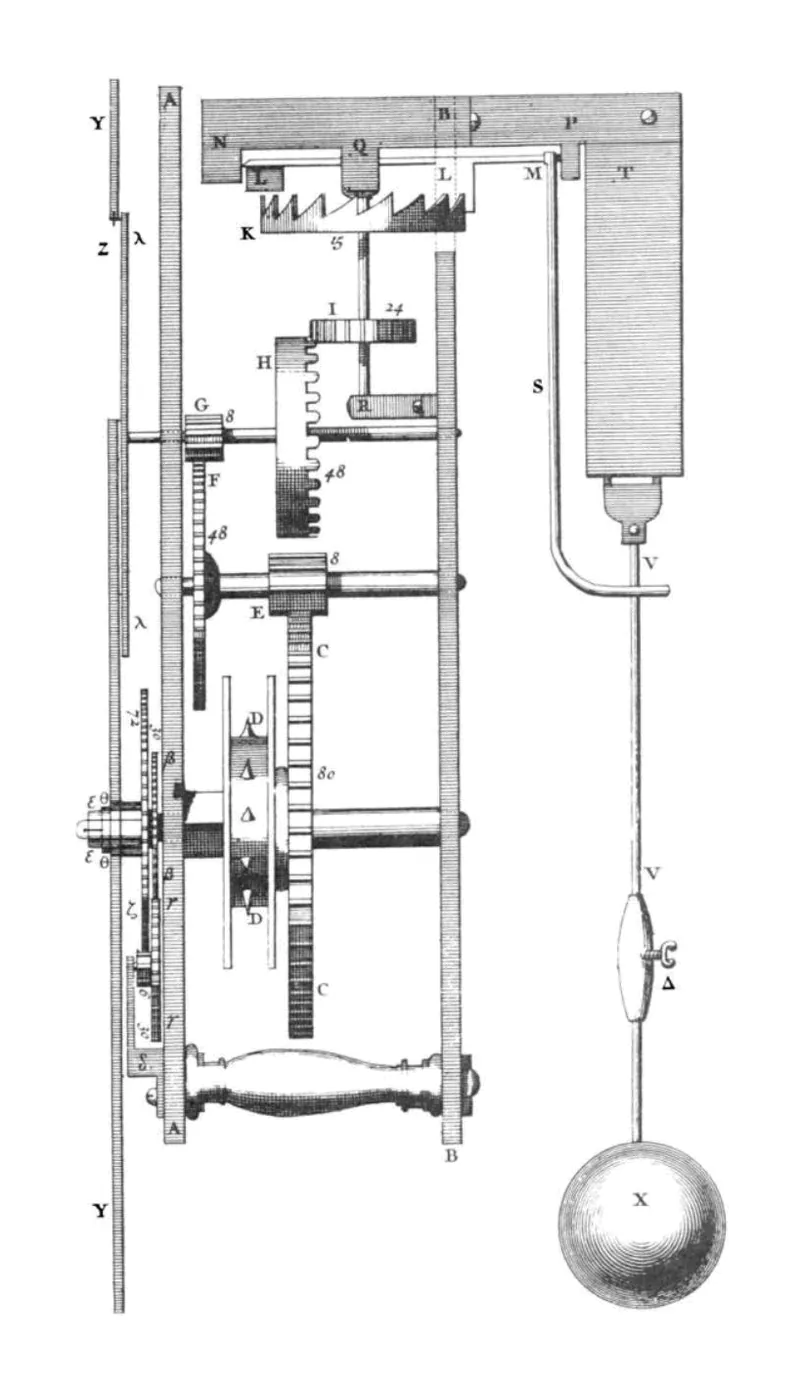
Huygens described the pendulum as a clock regulator in his book Horologium (1658), and published Horologium Oscillatorium in 1673. Britannica
Huygens made the period truly constant with a pivot that made the bob swing along a curve called a cycloid instead of a circle. Britannica
His early pendulum clock was out by less than a minute a day, a first; later versions by less than 10 seconds. NIST
Who invented the pendulum clock? Sources differ
- Some authorities credit Galileo with the pendulum clock and others Huygens. Britannica
- Christiaan Huygens made the first pendulum clock in 1656. NIST
- NIST says Galileo was studying the pendulum as early as 1582, and sketched a pendulum clock but never built one before he died in 1642. NIST
Galileo had the idea and a sketch; Huygens built it and made it work.
The same Huygens found the true shape of Saturn’s rings and one of its moons. Britannica
Wall clocks, then grandfather clocks
The new eight-day wall clocks had very heavy weights, and many fell off weak plaster walls. Britannica So the case was stretched down to the floor, and the grandfather clock was born. Britannica
Closer to perfect
In 1721 George Graham got a pendulum clock to within a second a day by correcting for the rod growing and shrinking with temperature. NIST
Siegmund Riefler’s clock of 1889 kept time to a hundredth of a second a day. NIST
The 1921 Shortt clock had two pendulums: a slave that did the work and gave the free master pendulum its gentle pushes. NIST
Our view: the pendulum is the best kind of invention, a thing everybody had seen for thousands of years until one person noticed what it was doing.
Next: springs and watches →