Springs and watches: clocks you can carry
Swap the falling weight for a coiled spring and a clock fits on a shelf, then in a pocket.
How this site works. Every fact is in our own words and linked to its source, beside it. Where good sources disagree, we show each version in a “Sources differ” box.
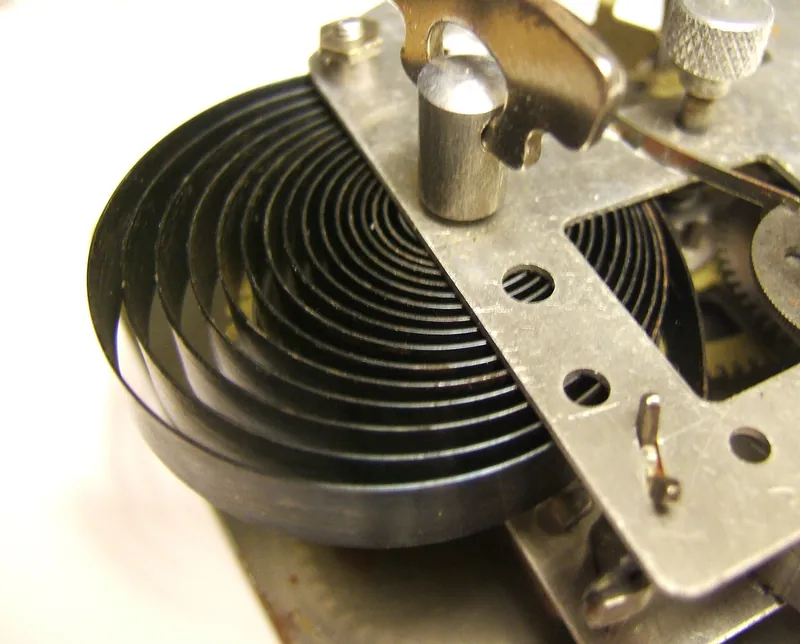
The mainspring, which drives a watch, is a flat band of spring steel; winding it coils it tighter and stores energy. Britannica
The first spring clocks
When did spring-driven clocks appear? Sources differ
- Britannica says spring-driven clocks first appeared about 1450, probably in southern Germany or northern Italy, the first portable timepieces. Britannica
- NIST credits spring-powered clocks to Peter Henlein of Nuremberg, between 1500 and 1510. NIST
- Britannica says the first watches appeared shortly after 1500, with early ones made by Henlein, a locksmith in Nürnberg. Britannica
Early spring clocks ran slower as the mainspring unwound. NIST
The dials of the first spring clocks usually had only an hour hand; minute hands were rare until the 1650s. Britannica
Until about 1580 German watch movements were almost all iron; then brass came in. Britannica
The fusee: an even pull
A mainspring pulls harder when fully wound than when nearly run down, a big problem for early watches. Britannica
The fix was the fusee: a cone-shaped, grooved pulley linked to the spring barrel by gut, later a chain. Britannica
Fully wound, the chain pulls on the narrow end of the cone; as the spring runs down it pulls on a wider part, so the leverage grows and the force stays almost even. Britannica
Modern watches use a going barrel instead, which drives the gears directly. Britannica
The balance and its spring
The balance spring does for the balance wheel what gravity does for a pendulum: it pulls it back so it swings to and fro. Britannica
Who invented the balance spring? Sources differ
- Robert Hooke designed a watch with a balance spring in the late 1650s, but there is no evidence it was a spiral. Britannica
- Britannica says Huygens was probably first to design a watch with a spiral balance spring, in 1674–75. Britannica
- NIST says Huygens developed the balance wheel and spring around 1675, letting watches keep time to 10 minutes a day. NIST
Jewels and self-winding
Good watches run their balance pivots in jewels; the first patent for watch jewels was taken out in London in 1704. Britannica
The first self-winding pocket watch patent was taken out in London in 1780; Louis Recordon’s self-winding wristwatch followed in 1924. Britannica
After clockwork
Quartz clocks beat pendulums because they have no gears or escapements to upset their steady vibration. NIST
Modern clocks are regulated by a balance wheel, a pendulum, a vibrating crystal or the workings of atoms. NIST
Next: the history of clocks →