Inside a clock: from the weight to the hands
Follow the energy from a falling weight, through the gears and the escapement, to the minute and hour hands.
How this site works. Every fact is in our own words and linked to its source, beside it. Where good sources disagree, we show each version in a “Sources differ” box.
A clock is a machine that links something moving in equal, regular steps to a counter that adds up the steps. Britannica
Every clock, 12-hour or 24-hour, works on that same principle. Britannica
The going train
A clock’s wheelwork, or train, is the row of gears that carries motion from the weight or spring, by way of the escapement, to the hands. Britannica
The wheels and pinions must be made accurately so the power flows as steadily as possible. Britannica
Power enters through the main, or great, wheel, which turns a pinion, whose rod carries the next wheel, and so on down to the escapement. Britannica
In clockmakers’ words, a pinion is a gear with few teeth, and an arbor is the turning rod the gears are fixed to. Britannica
Minutes and hours
The gear ratios are chosen so that one arbor turns once an hour and can carry the minute hand. Britannica
The cannon pinion, which drives the hands, turns once an hour. Britannica
A simple 12-to-1 gearing, the motion work, drives the hour hand from the minute hand. Britannica
A slipping clutch on the minute-hand arbor lets you set the hands. Britannica
Our own arithmetic: the hour hand goes round twice a day and the minute hand 24 times, which is exactly that 12 to 1.
The frame, the weight and the pendulum
The frame of a simple weight-driven clock is two plates held apart by four pillars. Britannica
The driving weight hangs from a line wound round a barrel, raised by turning the winding square or by pulling the line. Britannica
A crutch fixed to the pallet arbor ends in a fork that holds the pendulum rod. Britannica
A tower clock you can still see
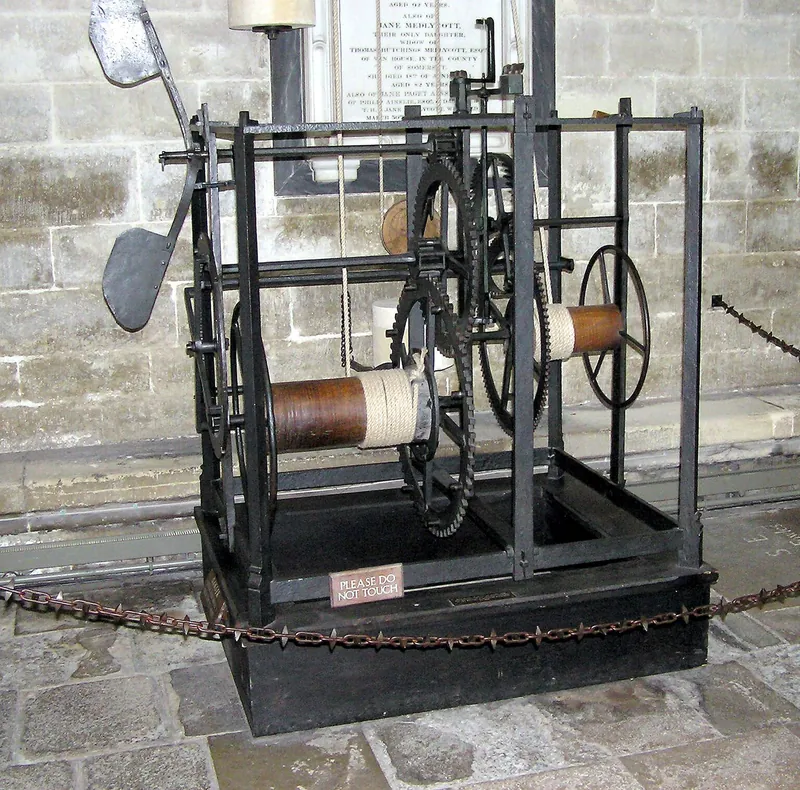
The oldest surviving clock in England is at Salisbury Cathedral, from 1386. Britannica
The same idea, in a watch
In a modern watch, the gears between barrel and escape wheel step the speed up about 4,000 times, using four pairs of gears. Britannica
Each pair in a watch usually steps up between 6 and 10 times, with pinions of only 6 to 12 leaves (teeth). Britannica
Next: the escapement →