From water clocks to tower clocks
Before the escapement, people measured time with dripping water, and built gears to model the sky.
How this site works. Every fact is in our own words and linked to its source, beside it. Where good sources disagree, we show each version in a “Sources differ” box.
The history of timekeeping is the search for ever steadier actions to set a clock’s rate. NIST
Water thieves
One of the oldest water clocks was found in the tomb of the pharaoh Amenhotep I, buried around 1500 BCE. NIST
The Greeks called water clocks clepsydras, “water thieves”. NIST
The Tower of the Winds in Athens, built in the first century BCE, had a 24-hour water clock. NIST
Water flow is very hard to control exactly, so water clocks could never be really accurate. NIST
The Antikythera mechanism

The Antikythera mechanism, an ancient Greek bronze device for showing the movements of the sky, was recovered in 1901 from a shipwreck near the island of Antikythera. Britannica
It is dated to about 100 BCE, give or take 30 years. Britannica
X-ray images showed 30 gear wheels inside the fragments. Britannica
Nothing geared that complicated is known again until medieval cathedral clocks, a thousand years later. Britannica
It was made of bronze sheet and was probably in a case about the size of a shoebox. Britannica
A hand-turned shaft is thought to have driven the main gear, one turn for each solar year. Britannica
Its Moon gearing used epicyclic gears and a pin-in-a-slot to copy the Moon’s uneven speed across the sky. Britannica
A small dial showed when the Panhellenic games, including the ancient Olympics, were due. Britannica
Its exact purpose is still unknown. Britannica
Su Song’s clock tower
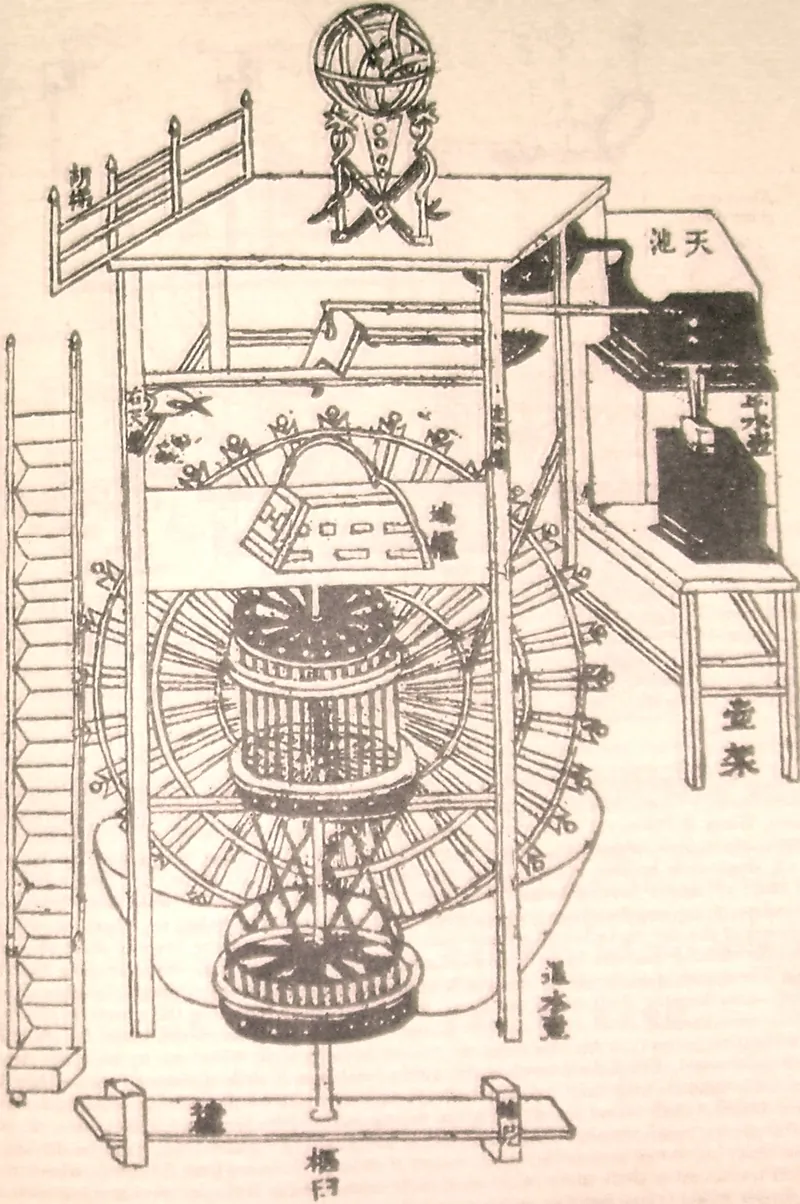
Su Song (1020–1101) built an armillary clock in a tower, powered by a waterwheel and a chain drive. Britannica
How tall was the tower? Sources differ
- Britannica gives the tower as 35 feet (11 m) tall. Britannica
- NIST says it was over 30 feet tall and built in 1088 CE. NIST
It used a water-driven escapement invented around 725 CE. NIST
Its mechanism used ideas not seen in Europe for hundreds of years. Britannica
Bells, monks and towers
No one knows where the all-mechanical escapement clock came from; the first may have rung bells calling monks to prayer. Britannica
The first mechanical clocks clearly recorded were big weight-driven tower (turret) clocks that struck the hours, with no hands or dial. Britannica
Which was the first mechanical clock? Sources differ
- Britannica names the oldest known mechanical clock as one added to Dunstable Priory in Bedfordshire in 1283, which had no face. Britannica
- The oldest surviving clock in England is at Salisbury Cathedral, from 1386. Britannica
- NIST says big mechanical clocks appeared in the towers of Italian cities in the first half of the 14th century. NIST
The first recorded clock, the oldest that survives, and the first wave of city tower clocks are three different questions, so the answers differ.
A clock put up at Rouen in France in 1389 still survives. Britannica
These early clocks may have been out by as much as half an hour a day. Britannica
Next: Harrison and longitude →