John Harrison and the clock that found the sea
To know where you are east or west at sea, you need to know the time at home. That needed a clock that could survive a ship.
How this site works. Every fact is in our own words and linked to its source, beside it. Where good sources disagree, we show each version in a “Sources differ” box.
A problem worth a fortune
On 22 October 1707 five of Admiral Shovell’s ships struck rocks off the Isles of Scilly, and more than 1400 men died. RMG
Spain set up the first longitude reward scheme, in 1567. RMG
Britain’s Longitude Act became law on 9 July 1714, offering a public reward for finding longitude at sea. RMG
The carpenter clockmaker
John Harrison was a carpenter who taught himself clockmaking. RMG
His precision longcase clocks of the mid-1720s kept time to a second a month. RMG
He aimed for a portable clock that kept time to within three seconds a day. RMG
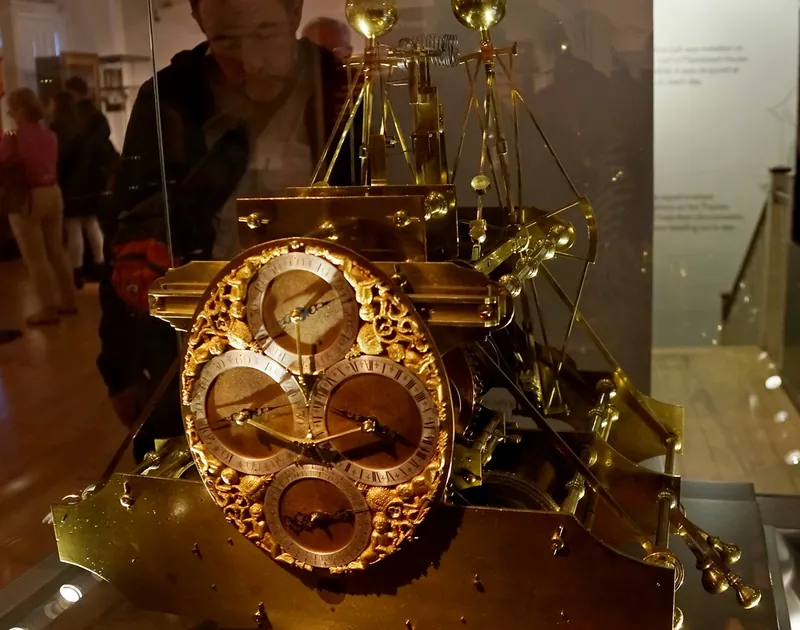
He brought his first sea clock, H1, to London in 1735; its two linked swinging balances made it ignore a ship’s motion. RMG
Returning from Lisbon in 1736, Harrison correctly said a headland was the Lizard, not the Start: the ship was 60 miles off course. RMG
He worked on H3 for 19 years. RMG
His clocks correct for temperature and, with clever anti-friction parts, run without any oil. RMG
H4: a watch, not a clock
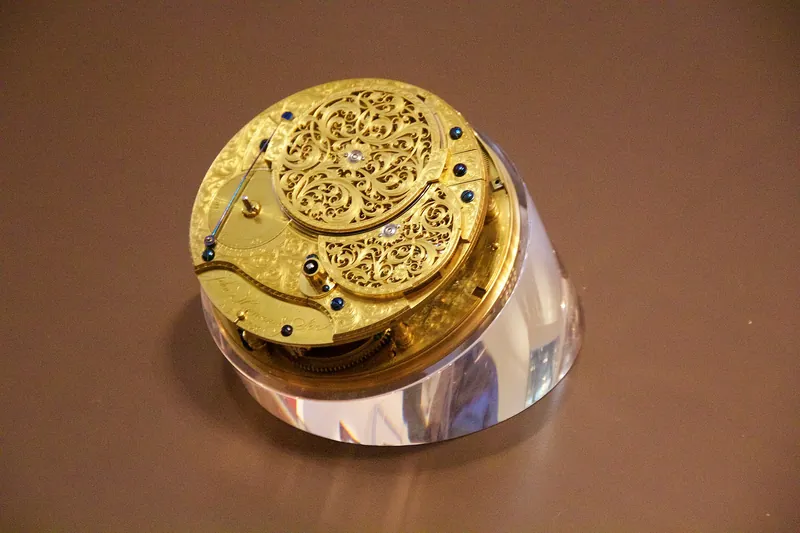
H4, finished in 1759, is Harrison’s prize-winning longitude watch. RMG
H4 has a 102 mm dial and weighs 1.45 kg. RMG
H4 ticks five times a second: its big balance beats faster and swings wider than a normal watch’s. RMG
On the 1761 trial to Jamaica, William Harrison used H4 to predict landfall at Madeira earlier than the crew expected. RMG
NIST says the chronometer kept time on a rolling ship to about a fifth of a second a day, 10 times better than the prize needed. NIST
Did Harrison win the prize? Sources differ
- NIST says that by 1761 it had won the British government’s 1714 prize. NIST
- Royal Museums Greenwich says the Board recommended only half the reward in 1765, the rest to wait until other makers could build similar timekeepers. RMG
- When the Royal Observatory tested H4 for 10 months from 1766, it did not perform well, and the dispute flared again. RMG
- Harrison was finally rewarded by Parliament, not by the Board of Longitude, and never got all he felt he was owed. RMG
NIST tells it simply: the clock won. Royal Museums Greenwich, who hold the clocks, tell a longer story of tests, rule changes and a reward that came from Parliament in the end.
Marine chronometers were expensive at first, so they spread slowly until simpler, cheaper designs arrived in the early 1800s. RMG
Royal Museums Greenwich displays the original H2, H3 and H4 and a replica of H1 at the Royal Observatory. RMG
Our view: whether or not the Board ever said so, a self-taught carpenter beat the best astronomers of his day at their own problem. That is the prize.
Next: play →